
Drow Society, Customs, and Taboos
Revised July 2026
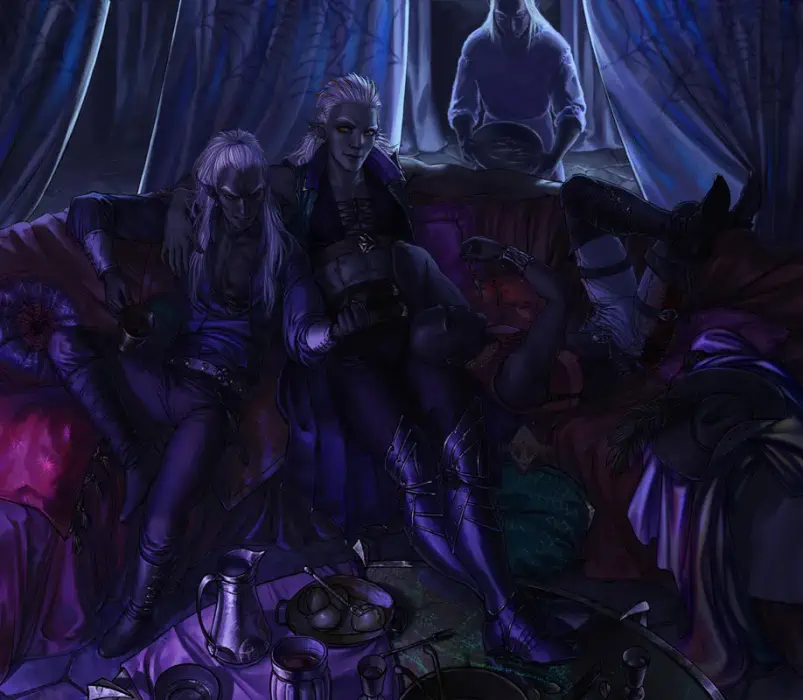
"Commission: strong argument" by EllirhShaan (resized) is licensed under CC BY-NC-ND 3.0
This page discusses Lolthite drow as infamously evil fictional villains for the entertainment of adult readers only. Please read with discretion and gain your group's consent before engaging these ideas in your games.
Lolthite Social Structure
Lolth sits at the center of her worshiper's lives, including the great webs of their societies, and her influence cannot be overstated. She may be fickle in many ways, but she's clearly favored female drow from the start and that has never changed. This has kept them at the top of every power structure in every settlement from time immemorial. Males have only ruled groups of Lolthain drow rarely and briefly, typically after things have gone very wrong. Even when male drow have the most experience and skill in a matter, they are placed below females and beholden to their will. Those with the patience and skill to manipulate their overseers have fared best but remain locked out of direct rulership.
The Church
To maintain her stranglehold on the drow, Lolth has supported her most ardent followers: the clergy. Through creatures, magic, and visions, she gives them the edge that keeps them in power. Thus her church rules the roost; all other organizations pay it homage and offer tribute. Her clerics can show up anywhere and inspect anything, and they do, usually when they aren't expected. This keeps everyone on their toes and makes conspiracies especially risky. In theory, the church can command, judge, and punish anyone but in practice, those outside its ranks are targeted more often and openly than those within it.
It should be noted that some drow settlements have governments other than Lolth's church. Menzoberranzan, for instance, has been ruled by a council of the most powerful matron mothers in the city. While those matrons may be clerics of Lolth, that isn't the case in every place. Some have councils of the heads of key guilds, a few are ruled by the highest cleric as a sole queen, and others have Lolth choose who and how many rule them via divine rites held on holy days (and she doesn't always choose those who directly serve her faith).
Noble Houses
Drow noble houses tend to descend from the loins of Lolth's most faithful and powerful followers but in some settlements, they spring from prominent drow outside of the church. Each house traces its lineage back to a paragon who made her mark through sheer power (character level), cunning, and/or deeds and began a lineage that continues to the present day. The core family in such houses are direct descendants of the paragon; others who pledge their loyalty can only advance so far without breeding into the main line. Noble families tend to have more members as well as more official roles (such as high priestess, mage, and weaponmaster) than commoner clans. And while they possess a range of professions and skills, noble houses eventually become known for prowess in particular areas of business and methods.
Guilds
A variety of guilds train members in valued skills and employ them in projects inside and outside drow strongholds. Guilds can afford to be picky, but entry is granted to those who are accepted by a master, complete the initial training, and satisfactorily resolve a series of tests. While complications arise - such as demands for payment or expensive components - strong performance often wins out. This keeps important trades from becoming the sole province of one family, a situation many drow would rather avoid. Families can and do align themselves with certain guilds, however; it's one of the best ways to improve their fortunes. The relative openness of guilds also means males can get in as well as females and the poor have a chance to join along with the rich. This is as close to egalitarian as it gets, though, and in every guild, females are shown more respect in public.
Guilds offer some prime opportunities aside from training and payment. Most have premises members can stay in so if a drow isn't doing well at home, they have a safe way to make their exit, so long as their matron allows them to leave. For as cutthroat as competition can be, a number of drow get along much better with guildmates than family. Additionally, guild business can take members outside of their settlements, far away from the prying eyes of Lolthite clerics and kin. This can be the closest to freedom members have ever experienced - a wonderful and risky time to explore different lands, ways of life, and even faiths. More than a few drow live for these assignments and a number of them fake their deaths while away so they never have to go home again.
Families
The next important organizing principle in drow life is the family unit. For all the difficulties of living together, the Underdark is too dangerous for drow to live for long on their own. And while trust is discouraged, at least they know what to expect from kin. Traditionally, the most influential mother - known as the matron mother - the males she chooses to breed with (usually known as her patrons), and her children make up the core of a family, but most families go beyond that core. The matron mother often allows others to stay on the property, such as favored (or useful) grandparents, siblings, and cousins. These things are as true for nobles as for commoners.
Lesser drow are herded into the general toil of a settlement. They produce many of the items and services the upper classes enjoy, whether they are part of guilds or not. Advancement is possible for lower-caste drow; indeed, a dredge of society who overcomes her betters is commended. Some males enter into military service to better their station; others become patrons. Motherhood is revered at all levels of drow society, and even poor women with many children are praised and granted extra regard by those above them.
Matron Mothers
Matron mothers rise in a variety of ways, from duels to inheritance to treachery. But for every brutal bully, there are smooth negotiators, psychological manipulators, and imperious queens. How a matron keeps her place varies but she must be keen and powerful in some way to take the reins. Throwing their power around isn't enough, however. Due to the dictates of Lolth, matrons must also survive a high rate of childbirth, have more living descendants than other mothers in the house, and produce daughters. In exchange, they are granted a great deal of power over all family members in the vicinity, including veto power over their major life choices. At their most extreme, matrons can kill males in the household - or order their deaths - without being questioned or punished.
Patrons
Any male drow a matron claims and keeps in her retinue as a mate is called a patron. Unlike children, patrons aren't ranked as first, second, or third in favor - not officially, at least. They stand to inherit nothing, so why bother? Unofficially, patrons vie for influence, especially once they produce children, and matrons usually have their favorites. Wise matrons employ patrons outside the bedroom, as well, using them to serve their personal interests or to benefit the family. Patrons can become personal secretaries, hosts for events, heads of family security, and so on. What they must never become - or believe themselves to be - is irreplaceable. A matron who relies on a patron heavily will be seen as weak and a patron who forgets his place will lose his life before long.
A drow can become a patron in a few ways. The first is by catching a matron's eye and receiving her opening offer, which is usually for a good time over one or two nights as a lover. If that good time exceeds expectations, she may propose a trial period or an indefinite stay as a patron. Regardless of the terms, turning down a matron's offer is dangerous and is only attempted by those who have powerful backers. Male drow may also be traded between matrons, with or without having any say in the matter. Perhaps a male has made too many mistakes or fallen out of favor; perhaps he has attractive qualities his ruling matron knows others want. Last but not least, a male can proposition a matron first. This may be the most dangerous way to a patron's place but can be the most exciting for both parties when it goes well.
Offspring
A drow female's children are hers, first and last. Since a female may have several lovers or patrons (or a mix of both), it can be impossible to know who the father of a child is without magical intervention. Many matrons don't look into the matter and keep the results private if they do, so the only parent their children can be sure of is them. They imply patrons are fathers of children at different points to keep them interested in their offspring's well-being while keeping them unsure. Some patrons scheme for the spells they need to learn their part; others avoid attachments that would break their heart. Either way, male drow have no legal say over anyone's future, including their own.
Children are ranked from early on in life. The highest tier of children are daughters, as decreed by Lolth. They may be ranked in birth order early on and ranked in order of favor later. The first daughter in her mother's esteem stands to inherit the lion's share of everything if and when her mother dies. The second and third daughters typically inherit something, while any other siblings gain little to nothing. In exchange, ranked daughters get more of their mother's attention and are expected to meet more of her demands. Male children are ranked similarly but as a measure of privileges they are indulged with currently instead of what they may gain later. They are also expected to do their mother's bidding more often. And all of these ranks are used to pit siblings against each other their entire lives, which keeps them from turning on their elders.
Childhood
On the surface, it seems drow mothers tend their infants as much as they wish and offload care onto other family members whenever they don't. But infants are delicate and valuable, especially daughters, so few mothers are as cavalier as they seem. They make a show of letting their babes cry and directing others to handle them but are quietly tracking whoever approaches their children. Kidnapping and worse are not out of the question, particularly for the offspring of matron mothers. At the same time, mothers can't be with their children at all times. Some rely on those most loyal to them while others rotate who cares for their kids on a whim to keep everyone on their toes.
As noted before, drow mothers almost always pick favorites and this begins from birth. Exceptionally beautiful infants may enjoy more affection while other mothers favor babies with loud, demanding cries. As they grow, children who learn to speak and act first tend to attract more attention, for better and worse. Regardless of how their parents feel about them, drow children are not coddled; no one can afford weak, spoiled offspring in the Underdark. They are encouraged to compete with each other early and fiercely, which means some of them do not survive long. The vast majority are raised at home among blood relatives, though some become wards of guilds or begin attending schools. Daughters are expected to surpass sons of their own accord so for once in their lives, they are not given advantages by their instructors.
Slavery
Slaves outnumber drow many times over and provide a great deal of labor, so they are part of the social structure. The complexities of drow slavery are covered here. If more detail on such matters seems distasteful to you, feel free to skip that page.
Social Customs
Laws and rules in Lolthite settlements shift between established decrees and silent expectations, common knowledge and spur-of-the-moment declarations. So how do drow know what to do and what to avoid? First, they learn to read the weather in the aura of the nearest authority figure. If those in charge aren't riled or close by, they can get away with more. The restrictions themselves are not as important as the ones enforcing them. But the challenge of breaking or following the rules is paramount. In the end, the goal of all social customs is to get what you want without being caught or punished for it.
Various high holy days of Lolth must be observed by all within a settlement (and outside of it, if devout females are present). Production of goods and services does not cease on such days however. Ceremonies are held after the workday ends, and drow in charge of protecting the city are not allowed to observe the holiday until they are given leave to do so. They cannot afford to leave themselves unprotected, even for an instant.
Taboos
Many surface-dwellers believe the drow have no taboos - that anything goes in their societies, no matter how horrific. This isn't true, of course; every society has taboos of some sort, no matter how small or strange, and the drow are no exception. Few foreigners spend enough time around them to learn what their taboos are and return to tell the tale, however. Below are some of their greater bans on social behavior:
Love: Whereas other races have taboos about things like cannibalism, the drow have strong social taboos about feeling and showing love for others. More on this can be found here.
Equality: As noted elsewhere, Lolothian drow may not treat other species as equals at any time, unless they are doing so as a means of deception. They must never think other species are equal to their own because Lolth has made it clear that they are not and never will be.
Other Gods: Lolth is a jealous deity, and the mere mention of most other gods can be grounds for punishment or death by her clergy. Worship of most other gods is absolutely forbidden.
Weakness: A great amount of fear is attached to showing one's throat to others in any overt way. Leaving oneself vulnerable invites other drow to take advantage of the opportunity in whatever way they fancy and leaves one open to ridicule for being victimized.
Torture & Punishment
Drow are infamous for their torture practices, as well they should be. Among elves, they were the first to experiment with the sensation of pain and they have honed torture into a science. While drow adults aren't all masters of torment, they've seen enough pain to know how to make others hurt. Not that all drow use physical pain as their modus operandi. A good many are adept at humiliation and terrible mind games, and a few feign care and sweetness. Some can't be bothered to play games and would rather kill someone than waste their time.
The worst punishments are said to come from those closest to Lolth, namely the yochlol and her clerics. They seem to be divinely inspired and ever-ready to enjoy making others suffer. In particular, drow are terrified of being turned into driders. Their horror doesn't come from the idea of being half-spider or only half-drow since both of those forms are blessed by the goddess. No, they dread being in the full sight of Lolth at the instant of the curse and losing their minds in the gaze of her multitudinous, crazed eyes. Then, after being broken, they'll get to survive as a reviled failure - she will see to it. Most will do nearly anything to avoid that fate.
<< Drow Appearance Drow Relations >>